IMMIGRATION LAW FIRM SEO • DIAGNOSTIC GUIDE
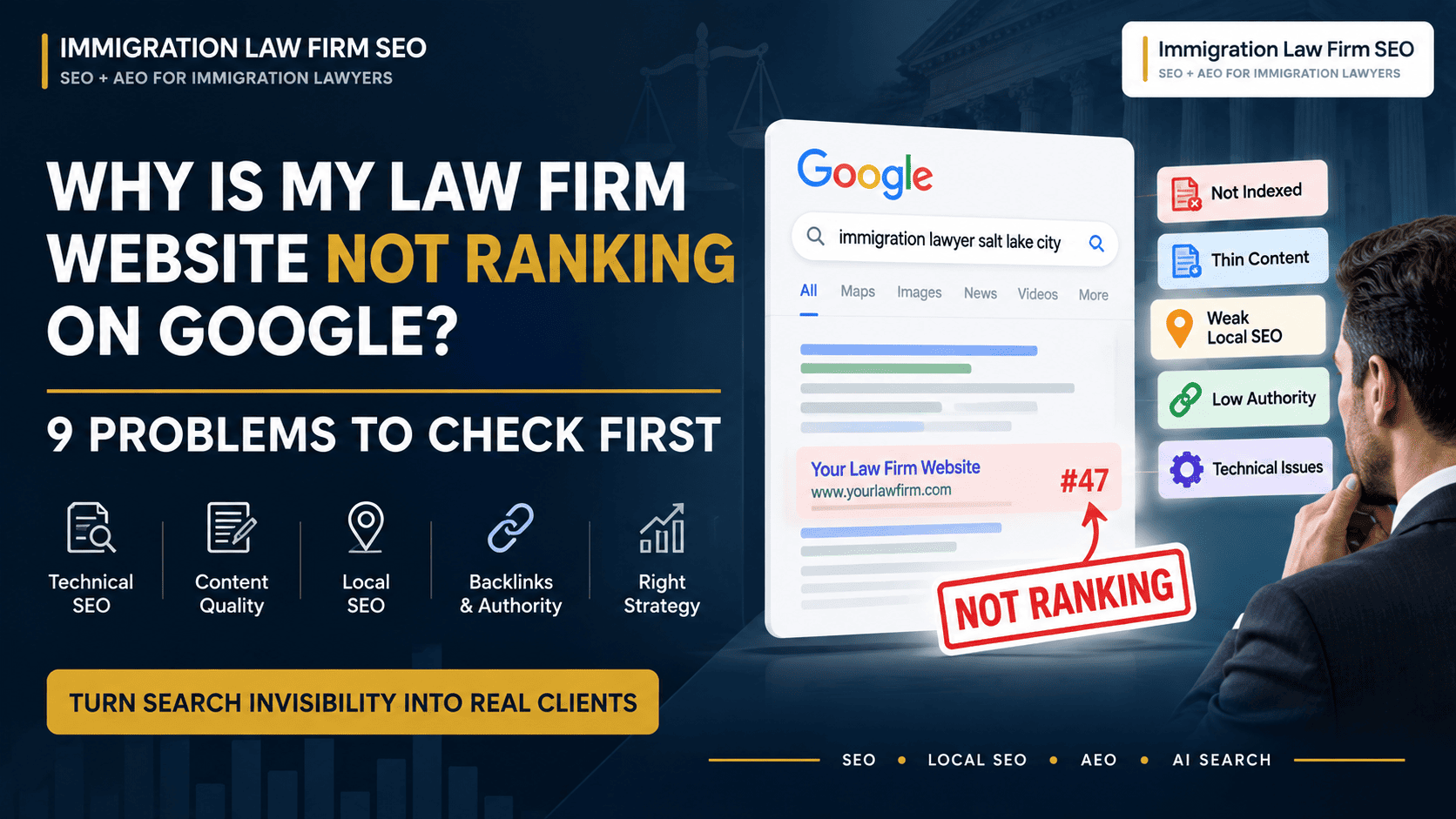
Why Is My Law Firm Website Not Ranking on Google? 9 Problems to Check First
Written by Jiad Hassan | Immigration Law Firm SEO, AEO & AI Search Strategist
Your law firm has a website. It looks professional. Your practice areas are listed. Maybe you’ve even published blog posts and hired an SEO company.
Yet when you search Google for the services you want to be known for, your firm is nowhere to be found.
So, why is my law firm website not ranking on Google?
Usually, there isn’t one magic setting or one missing keyword. The first job is to determine what kind of visibility problem you actually have. Google may not be indexing important pages. Your pages may be targeting the wrong search intent. Your local signals may be weak. Your content may be too generic. Or your site may be receiving impressions without turning them into clicks or consultations.
Google itself explains that a page can be indexed and still not appear for a particular search because the content may not be relevant enough, may not meet quality expectations, or may be prevented from being served for other reasons. (How Google Search works)
That is why I approach law firm SEO as a diagnosis first, optimization second process. For immigration law firms in particular, the goal is not simply to generate more pages. It is to build a search ecosystem that makes the firm’s services, locations, expertise and subject areas clear to both people and search systems. (SEO services for immigration law firms)
INITIAL ASSESSMENT
First, Figure Out What “Not Ranking” Actually Means
Before changing your website, identify which of these situations describes your firm.
What you see
What it may mean
First thing to check
Your website does not appear even for your firm name
Possible indexing or technical problem
Google Search + Search Console
Your firm name ranks, but important service terms do not
Relevance, intent or authority problem
Practice-area pages + queries
Your pages receive impressions but few clicks
Search-result presentation or intent mismatch
Query, title, CTR and page alignment
Your website ranks organically but not in Maps
Local search problem
Google Business Profile
Your pages exist but remain unindexed
Technical, quality or discovery issue
Page Indexing + URL Inspection
You get traffic but almost no enquiries
Conversion problem, not necessarily a ranking problem
Calls, forms and landing-page experience
This distinction matters because the fix for an unindexed page is completely different from the fix for a page sitting on page three.
Google recommends using Search Console’s Page Indexing and Crawl Stats reports, along with URL Inspection, when diagnosing whether Google can access and process important pages.
PROBLEM 01 • CRAWLABILITY & DISCOVERY
1. Google May Not Be Indexing the Pages That Matter
If Google has not indexed a page, that page cannot compete normally in Search.
Start by checking the Page Indexing report in Google Search Console. Then inspect your important URLs individually with the URL Inspection tool.
Look specifically at your:
- homepage
- main practice-area pages
- location pages
- attorney bio pages
- high-value articles
Google identifies several technical conditions that can affect indexing, including whether a page returns a successful status code, whether it has indexable content, and whether crawling or robots directives prevent access. (Review Google’s technical requirements)
A sitemap helps Google discover URLs, but submitting a sitemap does not guarantee that every URL will be indexed. Google explicitly makes that distinction in its crawling and indexing documentation.
A simple check
Search:
site:yourlawfirm.com
This is only a quick diagnostic, not a complete substitute for Search Console. If important pages are missing, inspect those URLs directly instead of immediately publishing more content.
For example, if an immigration firm’s website has dedicated pages for family immigration, adjustment of status, naturalization and deportation defense, but several of those pages are not indexed, creating ten more blog posts probably isn’t the first problem to solve. (If indexation issues persist across your domain, an in-depth immigration law firm SEO audit can pinpoint root causes.)
“Fix discoverability and indexation first.”
PROBLEM 02 • QUERY ALIGNMENT
2. Your Pages May Target the Wrong Search Intent
A page can be indexed, technically sound and still fail to rank because it is not the right answer for the query.
Google’s ranking systems are designed to return pages that are relevant to the searcher’s need. Google also notes that search results depend on the query and context, including factors such as location, language and device.
Consider these two searches:
“Immigration lawyer Salt Lake City”
The first has strong commercial/local intent. A searcher may be evaluating attorneys.
“What is adjustment of status?”
The second is primarily informational. A clear educational guide may be the better result.
They are both about immigration, but the intent is different.
If a law firm uses one generic page to target every possible immigration search, the page may fail to satisfy either intent particularly well.
Ask this for every important page
“What exact question is this page supposed to answer?”
Then ask:
Does Google currently show pages like this for that search?
For commercial queries, Google may favor service pages or local pages.
For informational queries, Google may show guides, government resources, explanations, or other educational content.
Your page needs to match the job the searcher is asking it to do.
PROBLEM 03 • SITE ARCHITECTURE
3. Your Homepage Is Trying to Rank for Everything
One of the most common structural problems with law firm websites is putting every practice area on the homepage and expecting Google to understand that the homepage should rank for all of them.
A homepage can establish who the firm is, where it operates and what it does.
It should not have to carry the entire topical burden of the website.
A stronger structure looks more like:
Homepage
→ Immigration Law
→ Family Immigration
→ Employment-Based Immigration
→ Naturalization
→ Removal Defense
→ Asylum
→ Individual Supporting Guides
→ Immigration Law
→ Family Immigration
→ Employment-Based Immigration
→ Naturalization
→ Removal Defense
→ Asylum
→ Individual Supporting Guides
The precise structure depends on the firm’s actual services.
This is especially important for immigration firms because searches can be divided by service, visa category, legal problem, audience and location.
A dedicated page gives the topic somewhere to live.
The blog then supports that page rather than competing with it. (See how we architect dedicated immigration law firm SEO services around clear service silos.)
PROBLEM 04 • CONTENT DEPTH & TRUST
4. Your Practice-Area Content Is Too Thin or Generic
Having a page called “Immigration Law” is not the same as demonstrating useful expertise on the problems potential clients are searching for.
Current law-firm SEO discussions repeatedly identify thin, generic or templated practice-area content as a common weakness.
The problem is not simply word count.
A 3,000-word page can still be generic.
A useful service page should make clear:
- what service the firm provides
- which problems it handles
- who the service is for
- which jurisdiction matters
- what the process involves
- what factors may affect a case
- what questions prospective clients commonly ask
- who is providing the service
- how the reader can take the next step
For legal content, trust also matters. Google’s documentation explains that its systems seek signals associated with experience, expertise, authoritativeness and trustworthiness, with stronger E-E-A-T particularly relevant to topics that can significantly affect people’s well-being or financial stability. (Google’s people-first content guidance)
That does not mean adding an “E-E-A-T” section to every page.
It means making the page more credible to a real person. (Learn how to structure authoritative immigration law content SEO that builds genuine trust.)
PROBLEM 05 • LOCAL VISIBILITY
5. Your Local Search Signals Are Weak
A law firm can have a well-optimized website and still struggle with local visibility.
Google says local results are mainly influenced by relevance, distance and prominence. It also recommends maintaining complete and accurate Business Profile information. (Google’s local ranking guidance)
That means your local search presence should be evaluated separately from traditional organic rankings.
Look at:
Google Business Profile
Is the profile verified and complete?
Does the business information accurately reflect the firm?
Are the services and categories appropriate?
Local relevance
Does the firm’s website clearly explain the markets it serves?
Prominence
Does the firm have meaningful references and links from other websites?
Does it have a legitimate review presence?
Consistency
Do important external references identify the firm consistently?
For a Salt Lake City immigration lawyer, for example, showing Google exactly what the firm does and where it operates is more useful than simply repeating “Salt Lake City immigration lawyer” in every paragraph.
Local relevance comes from the entire business/entity context, not keyword repetition. (Explore our specialized approach to local SEO for immigration lawyers.)
PROBLEM 06 • TOPICAL REINFORCEMENT
6. Your Internal Links Aren’t Reinforcing Important Pages
A law firm can publish excellent articles and still leave Google with a weak understanding of which pages matter most.
Suppose an immigration firm publishes:
How Does Adjustment of Status Work?
The article should naturally connect to the firm’s relevant service page, where appropriate.
Then another article about:
Adjustment of Status Interview Questions
can link to the first guide and the relevant service page.
This creates a logical relationship:
Informational guide
↓
Related guide
↓
Commercial service page
↓
Related guide
↓
Commercial service page
Google recommends a logical site structure and relevant internal links so its systems can discover important pages and understand the site’s relationships. It also recommends concise, descriptive anchor text.
This is one reason I do not treat blogging as an isolated activity.
“The blog should strengthen the service architecture.”
For an immigration law firm, that might mean:
Immigration Lawyer SEO
↓
Local SEO guide
↓
Google Business Profile guide
↓
Immigration keyword research guide
↓
Service-page architecture guide
↓
Local SEO guide
↓
Google Business Profile guide
↓
Immigration keyword research guide
↓
Service-page architecture guide
Each piece should have a reason to exist. (Discover how this aligns with an integrated SEO strategy for immigration law firms.)
PROBLEM 07 • TECHNICAL FOUNDATIONS
7. Technical Problems Are Holding Back Otherwise Good Pages
Technical SEO is not about chasing every audit warning.
It is about removing problems that prevent Google from properly accessing, processing or serving the pages that matter.
Google’s technical requirements include basics such as a working page, indexable content and accessibility to Googlebot. Search Console’s Page Indexing and Crawl Stats reports can help identify problems.
For a law firm website, check for issues such as:
- accidental noindex
- robots.txt restrictions
- server errors
- incorrect canonical tags
- redirect problems
- broken internal links
- pages that are difficult to discover
- mobile rendering problems
- duplicate or near-duplicate pages
- important content hidden from crawlable HTML
Do not make the mistake of assuming that a clean technical audit automatically creates rankings.
A current legal SEO audit discussion makes this distinction well: technical cleanliness and competitive search visibility are related, but they are not the same problem.
A site can be technically healthy and still lose because another page better satisfies the query. (Explore our dedicated technical SEO for immigration law firms.)
PROBLEM 08 • TOPICAL AUTHORITY & CREDIBILITY
8. Your Site May Not Have Enough Authority and Trust
Sometimes everything on the page looks reasonable, but the competitive environment is simply stronger.
Google’s own guidance encourages creators to produce unique, helpful information and explains that its systems consider factors associated with trust and authority.
For a law firm, authority can be reinforced by more than backlinks.
Think about the whole picture:
- Who is the attorney?
- Are attorney credentials and professional information easy to understand?
- What does the firm actually handle?
- Are important practice areas clearly represented?
- Does the firm’s website connect its expertise to useful content?
- Is the firm mentioned consistently elsewhere?
- Do reputable websites reference the firm?
- Does the content provide genuine information rather than generic legal marketing copy?
This is where topical authority becomes useful.
Instead of publishing random legal articles, build a coherent body of content around the firm’s actual expertise.
For an immigration firm, that could involve connected coverage of visa categories, eligibility questions, procedures, common problems, deadlines, local service information and related client questions.
The goal is not to publish the most pages.
The goal is to build the clearest useful resource around the firm’s subject areas.
PROBLEM 09 • ANALYTICS & DIAGNOSTICS
9. You May Be Measuring the Wrong SEO Problem
A law firm can be “not ranking” in the owner’s mind while the real problem is somewhere else.
Google Search Console gives you several useful signals:
Impressions: how often your site appeared.
Clicks: how often someone clicked.
CTR: the percentage of impressions that resulted in clicks.
Average position: the reported average position for your results.
These numbers help separate different scenarios.
High impressions + low clicks
Your page is being seen, but the search result may not be compelling or the page may not align well with the query.
Low impressions + reasonable rankings
You may be targeting a small set of searches or a narrow topic.
Lots of impressions + rankings around page two
This can indicate an opportunity to improve relevance, content depth, authority, internal linking or other competitive factors.
Traffic + no consultations
That is not necessarily an SEO ranking failure.
It may be a landing-page, messaging, intake or conversion problem.
This is why I prefer to look beyond rankings.
A law firm’s search strategy should eventually connect:
Query → Impression → Click → Visit → Contact → Consultation
Search Console helps with the first part of that chain. Analytics and conversion tracking help with what happens afterward.
AI SEARCH & ANSWER ENGINES
What About Google AI Overviews and AI Mode?
This is increasingly relevant to law firms, but it is important not to confuse AI visibility with a separate SEO system.
Google’s current documentation says the same foundational SEO practices remain relevant for AI Overviews and AI Mode. There are no additional technical requirements or special AI schema requirements just to appear in those experiences. Google also says pages generally need to be indexed and eligible to appear in normal Search.
Google’s newer AI-search guidance emphasizes valuable, unique, non-commodity content rather than special AI tricks.
That matters for law firms.
A useful immigration article should be understandable to:
- a potential client
- a search engine
- an answer engine
- an AI system trying to understand entities and relationships
The same fundamentals help all of them:
clear entities + useful answers + strong context + reliable sources + accessible content + logical internal links
That is the philosophy behind my approach to SEO, AEO for immigration lawyers, GEO and AI-search visibility.
The objective is not to create content that sounds like it was written for a machine.
The objective is to create something a machine can understand because a human actually finds it useful.
PRACTICAL AUDIT WORKFLOW
A Practical 30-Minute Law Firm SEO Diagnosis
Before paying for another round of SEO work, run through this sequence.
Step 1: Search your own firm name
Does the official website appear?
If not, investigate indexation and technical issues first.
Step 2: Check Search Console
Look at:
Pages → indexing status
Then inspect a few high-value URLs individually.
Step 3: Check the queries
Open:
Performance → Search results → Queries
Look for terms where your site already receives impressions.
Google specifically recommends using query and page data to understand what brings visibility and where pages may be underperforming.
Step 4: Pick one high-value service
Take one service your firm genuinely wants more clients for.
Search it manually.
Look at the type of pages Google is returning.
Step 5: Compare the page types
Are competitors using:
- dedicated service pages?
- location pages?
- detailed guides?
- strong attorney profiles?
- local results?
- directories?
- government sources?
This tells you what type of page is competing.
Step 6: Check your internal links
Can Google and users reach that service from relevant pages?
Step 7: Check local visibility
Search the service with the firm’s location.
Then check Google Maps separately.
The website and the local pack are related, but they are not identical search systems.
PRIORITIZATION & SEQUENCING
How to Fix the Problem in the Right Order
Don’t start by ordering 50 new blog posts.
Don’t start by rewriting every meta description.
Don’t start by buying backlinks because a report says “authority is low.”
Start with the biggest constraint.
A sensible sequence is:
1. Indexation
Make sure important pages can be crawled and indexed.
2. Search intent
Make sure each important page is designed for the query it is supposed to satisfy.
3. Site architecture
Create clear practice-area and service relationships.
4. Content quality
Improve thin or generic pages with useful, specific information.
5. Local SEO
Strengthen legitimate local signals where local intent exists.
6. Internal linking
Connect supporting information to important commercial pages.
7. Authority
Build credible external references and useful content worth citing.
8. Measurement
Track impressions, clicks, rankings and actual business outcomes.
That sequence prevents one of the most common SEO mistakes: spending more money on a symptom while leaving the underlying problem untouched.
LEGAL SPECIALIZATION
For Immigration Law Firms, the Diagnosis Needs One More Layer
A generic legal SEO checklist can miss some of the nuances of immigration search.
An immigration firm may need to organize its content around relationships such as:
Attorney → Immigration Law
Immigration Law → Visa Category
Visa Category → Eligibility
Eligibility → Process
Process → Common Problems
Service → Location
Attorney → Jurisdiction
That structure can create a much clearer topical model than repeatedly publishing variations of:
“Best Immigration Lawyer in [City]”
For example, an immigration firm serving Salt Lake City might have a commercial service page targeting its core local service while supporting it with genuinely useful resources around the firm’s actual practice areas.
That is where my specialty differs from generic legal SEO.
“I focus on the intersection of immigration-law search intent, local visibility, topical authority, AEO and AI-search visibility, rather than treating every law firm website as though it were the same type of business.”
QUESTIONS & ANSWERS
Frequently Asked Questions
Why is my law firm website not ranking on Google?
The cause may be technical, content-related, competitive, local, or structural. First determine whether Google has indexed the page, then check whether the page matches the query’s intent and whether your website provides enough relevance, useful information, internal context and authority to compete.
Why is my law firm not showing up on Google at all?
Start by checking whether your website appears when searching your domain or firm name and then use Google Search Console’s Page Indexing and URL Inspection tools. If important pages are not indexed, resolve that problem before focusing on rankings.
Why does my law firm rank for its name but not its services?
Brand-name searches and service searches have different intent. A firm may have enough relevance to appear for its own name while lacking dedicated pages, topical depth, local relevance or authority for competitive commercial queries.
Does my law firm need a blog to rank?
Not necessarily. A blog can strengthen topical authority and answer informational searches, but it should support the firm’s important service pages rather than exist simply to increase the number of URLs on the site.
How long does law firm SEO take?
There is no universal timeline. It depends on the site’s current condition, competition, content quality, authority, search intent, technical issues and the amount of work being implemented. Rankings should be evaluated alongside impressions, clicks and business outcomes rather than on an arbitrary deadline.
Why isn't my law firm showing in Google Maps?
Google says local rankings are mainly based on relevance, distance and prominence. A website ranking organically does not guarantee the same visibility in the local results, so your Google Business Profile and local search presence should be evaluated separately.
Will AI Overviews replace traditional law firm SEO?
Google’s current guidance does not support treating AI search as a replacement for foundational SEO. Google says the same core SEO practices remain relevant for AI Overviews and AI Mode, and indexed pages can be used as supporting links in those experiences.
STRATEGIC SUMMARY
Conclusion
When a law firm website is not ranking on Google, the wrong first question is usually:
“What SEO trick am I missing?”
A better question is:
“Which part of my search visibility system is failing?”
- Is Google unable to index the page?
- Is the page targeting the wrong intent?
- Is the site missing dedicated practice-area content?
- Are local signals weak?
- Are internal links failing to reinforce your important services?
- Is the website technically sound but lacking competitive authority?
- Or are you receiving visibility already, but measuring the wrong outcome?
Once you know which problem you actually have, the solution becomes much clearer.
For immigration law firms, that diagnosis should go one step further. Search visibility now touches organic SEO, Local SEO, topical authority, AEO and AI-search visibility. Those pieces should not be treated as five unrelated marketing tactics. They should reinforce one another.
That is the approach I use at Immigration Law Firm SEO: build a search ecosystem around the firm’s services, expertise, locations and client questions so that the website is useful to people and understandable to modern search systems.